Pleneuf-Val-André: The Two Holes You Came For
- Gunnar Kobin
- May 18
- 5 min read


After Etretat we moved bases. Drove from the Normandy cliffs down to Dinard, just over the Brittany border on the Emerald Coast, where we were going to be for the rest of the week. The plan for day five was a sixty-minute drive west along the bay of Saint-Brieuc to Golf de Pleneuf-Val-André, a course I had been told about a few times over the years and had never quite got round to playing.
It is a course held together by two holes. The whole round is fine, in places very good, in places average. But the reason anyone gets in a car and drives to Pleneuf is the tenth and the eleventh, which between them are as good a pair of sea holes as you will find on the continent.
A bit of background. Pleneuf-Val-André opened in 1992 and was designed by the French architect Alain Prat. Prat is generally considered one of the steadier modern French course architects, and Pleneuf is the work of his that gets cited most often. The course hosts the Open de Bretagne, a Challenge Tour event, in most years. The eleventh hole is genuinely famous in French golf, with a tee box perched on a small rocky platform fifty metres above the beach and a fairway that runs parallel to the Channel toward a green set back into the cliff. One of the lists has it in the top 500 holes in the world. I do not entirely buy the precision of that ranking, but I will go along with the principle of it.
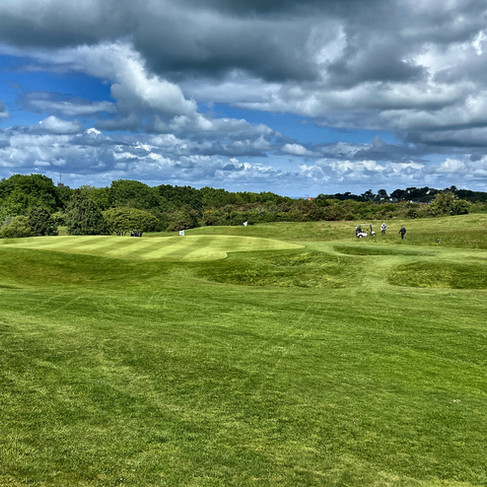
We started our round around midday, after the drive over from Dinard. The weather, which had finally come good earlier in the week, held. The course had clearly been waiting for it. The conditioning was the best of the trip so far. Firm fairways, true greens, the rough trimmed to the just-cooperative side of difficult.
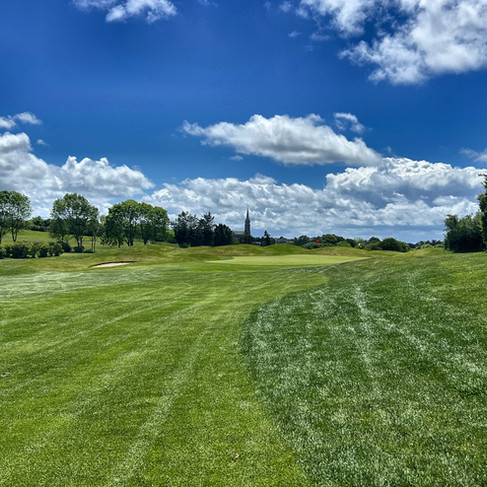
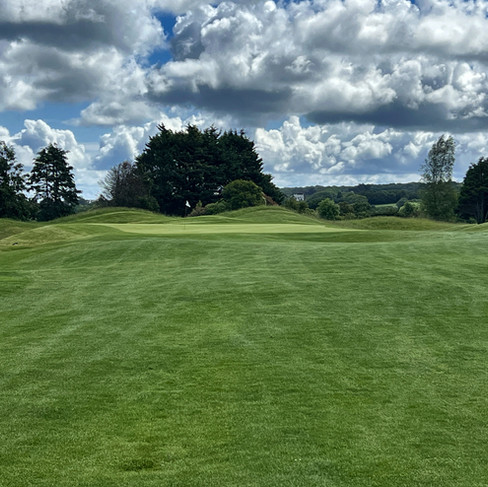
Pleneuf is hilly. Not viciously so, until the section where the routing drops down toward the beach and you spend the next few holes climbing back up. The course mostly sits up on the headland, between hedges of windblown gorse and pine, with sea views appearing between the trees on most holes and disappearing again. The fairways from the yellow tees are wide enough that you can hit driver on most of them, but the rough is US Open thick. Fifteen metres off line and you are not playing a shot, you are looking for the ball. The bunkering does sneaky work as well. There are several spots on the course where a bunker is in your natural landing zone and not visible from the tee, which is the kind of thing you only find out once.
The front nine plays mostly inland, gently up and down, the sea suggested rather than seen. None of it is weak. The seventh, a par five of 417 metres, punished me hard for a careless second shot, and I treated it as a hole that takes prisoners. The ninth winds back toward the clubhouse and the small turn area, where there is a coffee machine and a view of the bay that hints at what is coming.
Then you walk to the tenth tee.
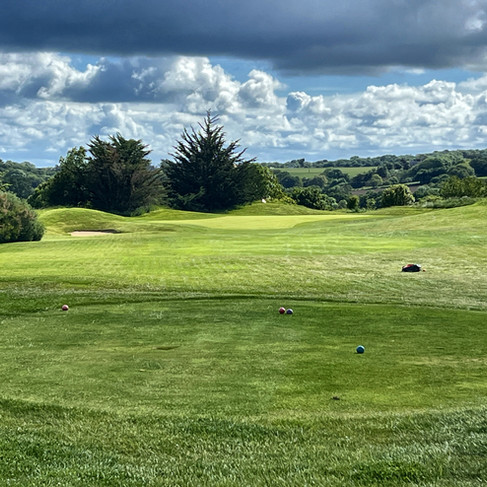
The tenth is a short par four, 287 metres from the yellows. The tee box sits well above the fairway and the green is hidden over the brow of the hill and tucked down toward the cliff. There is a single white aiming stick on the horizon that gives you a line to the green you cannot see. You stand on the tee with two choices. The first is to hit driver at the white stick, blind, trusting that the fairway will hold your ball and that whoever is on the green up ahead is far enough out of your line that you are not about to ruin their afternoon. The second is to play an iron to about 130 metres out, into a narrow strip of fairway you can see, and from there have a downhill approach to a green you can actually look at, accepting that you have given up the realistic chance of going for it. I played option two. Most of our group played it differently from each other, which tends to be the sign that the architect has done his job.
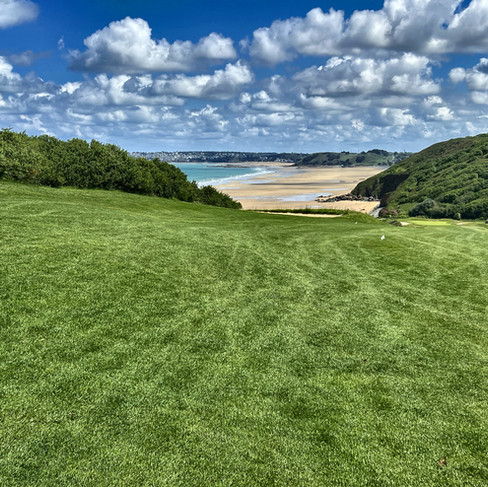
The eleventh is the famous one and it earns the reputation. You walk up to a tee box that is barely a teeing platform, on a rock outcrop with the cliff dropping away on the left and the beach fifty metres below and the bay opening out in front of you. The hole is a par five of 442 metres, the fairway running along the cliff line, with the green tucked into a corner you have to coax your third shot into rather than attack. Standing on that tee is the kind of view that quiets a four-ball. We took photographs. I made bogey, which was the best I could have hoped for given what was happening between my ears.
After the eleventh, the course climbs back up. The walk from the twelfth green to the thirteenth tee is the steepest piece of pure golf-course walking I have done in years. There is no soft way to put this. If you are the sort of player who would normally rather walk, this is the round where you take the buggy. We did not. By the time we had finished the climb up to the thirteenth tee, a short 140-metre par three, several of us were genuinely out of breath. I made six on that par three, which sounds bad and felt worse. The next two holes recover from the climb, but you have already given some strokes back to it.
Honest critiques. The greens were good in most places, slightly inconsistent in a couple. The signage between holes was acceptable. The clubhouse is small, and they stop serving hot food at fourteen hundred, which by this point in the trip we had come to accept as a quirk of golf in this part of France. We had learnt the lesson from Etretat the day before and ordered hot food at the turn rather than waiting until after. The view from the clubhouse, looking out over Verdelet and the bay, is one of the better ones on the trip.
A practical note on the routing. Take the buggy. None of the eight of us did, and by the seventeenth tee that decision was being openly regretted by most of the group. The cliffs are part of why you come to Pleneuf. They are also part of why the round is more physical than the card suggests.
Final word. Pleneuf is worth the drive from Dinard or Saint-Malo. It would be worth it for the eleventh alone. The tenth is a serious decision hole, the conditioning is excellent, and the climb between twelve and thirteen will live in your legs for a day afterwards. It is not a championship test in the way La Mer is at Le Touquet, but it is a course you remember in detail. Worth doing once, almost certainly worth doing again.
Read also my other blogs from the same region
















Comments