Le Touquet La Foret: The One I'd Leave Off
- Gunnar Kobin
- May 18
- 5 min read


If I had to drop one course from this trip's itinerary, this would be it. That is not quite a comment on Le Touquet La Foret being a bad course. It is a quieter, flatter, more straightforwardly parkland counterpart to La Mer next door, and it has its moments. The trouble is that almost all of those moments come up against the same problem: La Mer is fifteen minutes' walk away on the same green fee, and once you have played that, the bar is sitting somewhere La Forêt cannot quite reach.
A bit of background. La Forêt is the older of the two Le Touquet courses. The original was laid out in the early 1900s by Horace Hutchinson with Nick Lane Jackson, on the wooded inland side of the resort, and was inaugurated by Lord Balfour when he was British prime minister. That is the kind of opening ceremony you would struggle to put together today. The course has been remodelled many times over the past century, and in the early 2000s the French architect Jean-Claude Cornillot took on a major redesign, lengthening and reshaping a number of holes. Cornillot is the same architect who later co-designed Les Dunes at Hardelot down the coast, which is one of the small coincidences you trip over when you read about golf in this part of France.
We played La Forêt on the afternoon of the second day, having walked La Mer in the morning. In retrospect, that was a scheduling mistake of mine as organiser. We were tired before we got to the first tee, the temperature had not really climbed from the ten degrees we had started at that morning, and there is only so much an afternoon parkland course can do for legs that have already done eighteen holes of links golf.
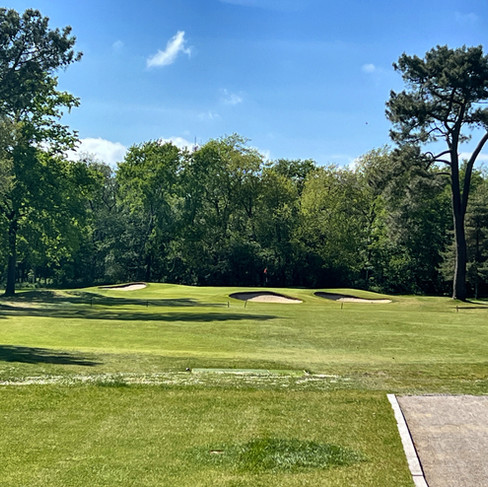
Geographically and visually, La Forêt is the opposite of its sister. Where La Mer climbs through dunes and exposed coastal ground, La Forêt sits in pine forest on broadly flat land that does not change much across eighteen holes. That alone is not fatal. Plenty of good parkland courses are flat. The trouble here is that flatness is paired with a routing that takes a while to find a rhythm.
The first three holes, frankly, do the course no favours. The opener is a 422-metre par five through a corridor that is neither tight enough to be a challenge nor wide enough to feel generous. The second is a short par four where the architect's intentions are not quite clear. The third is a 312-metre par four that you will struggle to remember a single feature of by the time you have walked off it. None of them is bad. None of them really earns your attention either. Judging the course on its opening sequence alone, you would be heading for the car park by the fourth tee.
It does improve. Once you get into the forest proper, around the fourth or fifth hole, the course finds something more interesting. The fifth in particular, a 446-metre par five, is one of the holes Cornillot pushed hardest in his redesign. It is a hole where the second shot genuinely matters and where laying up is a real strategic choice rather than a safety net. I personally made eight on it. Not the hole's fault.
There are flashes like that scattered through the round. The sixth, a short downhill par three at 135 metres, is a clean, fair, well-bunkered short hole. The eleventh, the longest par five on the card at 466 metres, opens up nicely and is reachable in two for a player hitting it well. The sixteenth, another par five, was also a focal point of Cornillot's redesign and it shows: a 436-metre hole where the fairway narrows progressively into a green ringed by mature pine, and the kind of green complex you actually have to think about before you commit to a club.
But there are also genuinely uninspiring holes in between. The tenth is a 320-metre par four where the design feels noncommittal, as if the architect couldn't quite decide between a position-play hole and a punchy short one, and the result is neither. The fourteenth at 295 metres has a similar problem. There are two or three short par fours of the kind that feel as though they used to be par fives once and got truncated in some past remodelling. The transitions between strong holes and weak ones are abrupt enough to leave you wondering whether you are playing one course or three.
The greens are what hold the whole thing together. Cornillot's surfaces are properly interesting: nice contour, good pace, plenty of subtle slope, fair without being meek. Standing on the first green I had assumed the rest of the round would be flatter and slower in every sense, and on the greens at least I was wrong. They were the equal of anything we played in Le Touquet or Hardelot. If you find yourself out there on a quiet morning with nothing else to do, the greens alone are worth the entry.
A handful of honest gripes. Pace of play on our round was slow, although that is not really the course's fault. The signage between holes is acceptable but not great. And the routing from the seventeenth green back to the eighteenth tee, and then back to the new clubhouse, is longer than a course this kind to tired legs ought to want at the end of a day. By the time we walked off the eighteenth, most of the group were looking for the bar with more enthusiasm than they were looking back at their cards.
Final word. La Forêt is a fine course that suffers from being next door to a much better one. If you only have a day in Le Touquet, play La Mer and forget La Forêt exists. With a second day, La Forêt is genuinely fine, especially in the morning when your legs are fresh and the greens have not yet been chewed up. On the afternoon of a 36-hole day, after the elevated drama of La Mer, it was always going to feel a half-grade lower than it might have done on its own.
If I would be planning this trip again, La Forêt would come off the itinerary. Either play La Mer twice or use the afternoon to drive somewhere new. Nothing personal. Just the reality of a trip that wants every round to pull its weight.
Read also my other blogs from the same region





Dear Sir,
Thank you very much for your detailed review and for taking the time to share your experience at Le Touquet Golf Resort.
We truly appreciate your thoughtful perspective on La Forêt. You have captured very well what makes this course unique: a historic and more understated layout compared with La Mer, offering a completely different experience in the peaceful surroundings of a beautiful pine forest. Its more traditional and intimate character is indeed the perfect contrast to the dramatic landscapes of its neighbouring links course.
The comparison between the two courses is, of course, inevitable, and we fully understand your perspective. La Mer impresses with its dunes, natural elevation changes and true links character, while La Forêt offers a quieter…