Pineapple Valley Golf Club – Where Logic, Restraint, and Local Knowledge Define the Score
- Gunnar Kobin
- Feb 1
- 7 min read

Updated: Mar 23

Pineapple Valley Golf Club Is Teaching Me New Lessons
This is now my second time playing Pineapple Valley (Banyan Golf Club) and once again, I am finding things to learn. I guess this says a lot about the course. I mean, considering all the other things I could say about it.
This is the golf club that is located the most to the southwest, out of all the golf clubs I have played so far. If you have played Black Mountain, you need to get mentally prepared, because this is totally the opposite. Black Mountain comes at you fast, with a lot of drama and big overwhelming statements. Pineapple Valley? Contrasting, has a lot of calm on the surface, but underneath the surface is continuously a mental chess game. This course is also equally a mental chess game. The course never yells at you, but you will easily get punished for being careless.
This is easily become one of my favorite courses on the whole coast of Thailand. The all provide the same type of emotion. Everything just makes sense. Nothing is trying to sell out for instagram likes, and when you make a mistake, it is usually because you have ignored things logically and just gone with being careless.
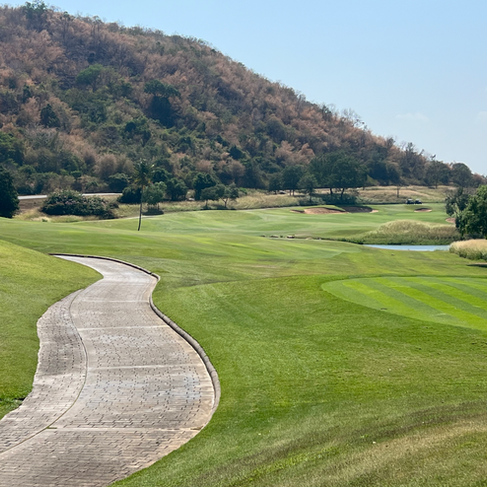
Situated beside the clubhouse, the entire landscape is impressive, and the entire experience is great and thorough. Wood and glass construction, exquisite design. There are views of the gentle roll of the fairways, sprawl of pineapple fields stretching to the horizon, rocky hills and the sea peeking through the cracks. No design effort is here to mask the overwhelming beauty of nature, rather it's the opposite. It's as if they found the right piece of nature and balanced the design idea with the nature.
Design Philosophy is Unique Here
The designer is Pirapon Namatra of Golf East, and Nikanti is also his work, although you'd never assume they share the same creator. Each work of his has brilliant individuality, and here he lets the land tell the story and he refrains from passing his dominant and imposing story. None of the fairways have been changed from where they ought to be, and the same goes for the bunkers which are only present where they're necessary and not for show.
The right angles on the approach shots are the only ones rewarded on the green. Their length is irrelevant. There are no forced carries to segregate the men from the boys or whatever that means. The challenge is positioned touch and the absolute evil of these greens and reading them. Better players get tested and that is how it should be.
I really admire the confidence of the design. Pineapple Valley does not need to go out of their way to prove anything. They know the smarter players will pick up on what is going on, and the less patient players will just take a lot of shots without fully understanding what is going on from a strategic standpoint.
Position Over Power
This course does not reward you for how hard you can hit a ball. It rewards you for where you can place it.
Of course, there are advantages for the long hitters, but only if they are able to deal with actual risks. For the rest of us, it is about control, thinking a few shots ahead and not trying to go for the big play. I doubt anyone standing on the tee here thinks, “just grip and rip it” and every tee shot needs a plan. The same applies to the approaches, they need to reach their location. Short game play around the green is the same — use your imagination, not just your sand wedge.
You move from open valleys to tighter areas by the mountains, and back again. The holes flow really well through the property, You never feel the same. it all fits together and each hole sets up the next one, no strange walks and abrupt changes.
Engaging, then Challenging
The start of each round is pretty accessible, you can find your range, establish a rhythm, even hit a few swings, and it's even forgiving up until you get a few questions: hold your shots, understand angled approaches and where to aim, take a few placed shots, etc.
As you keep playing, you're going to be confronted with some changes as the elevations start to shift and you'll find even more open, visually big drops, and it's going to lead some of you to think 'driver, big risk'.
Most of the time you back off and be more conservative with your shots and you'll find yourself with better outcomes, more often then not to some tucked pins, or where some of the browning, or near, sloping pins are going to find landing spots.
The Memorable Ones
Most of the holes here, with a few more look and realize layers each time, look pretty simple on the scorecard.
Most of the time, going for it and trying to short of the the long dead zone is going to be the back pin and going to testing your self control, or more often then not, it's going to catch the rest of us.
On the fifth hole, it might seem like the best choice would be to hit the driver out there, but it could be better to lay back to be short of the bunkers. This might seem counterintuitive, but going too far puts you in a very difficult position. This is the desired outcome to help you get used to playing the hole the correct way!
The 10th hole is even more uphill, and seems a lot more difficult with the longer distance. There is an interesting feature on the green though that can help with that. When the pin is to the left, you can actually aim far to the right. There is a slope on the green that feeds to the left. This is the exact opposite of how you would think you should play a hole, but if you didn’t know it was there, you would never go for it. This is the type of situation that a good caddy is necessary for.
The 16th hole looks very simple from the tee with around 200 meters to go. However, it is very downhill and the creek runs right in the valley of the hill. This means that there will be required control of distance, which adds a lot of extra difficulty. You should set your aim to the left of the middle tree, but if you go too far you can run out of the fairway. This hole has hidden strategic design, which actually means more precision than anything.
Finally, the 17th hole, a par three, taught me a valuable, if painful lesson about these greens. The hole is a right pin. If you are aiming for the hole, anything to the left of centre is pretty much an assured three putt. You need to hit the correct side for any chance of avoiding bogey, no matter how accurate your first putt is.
This is a good example as to why the course never gets boring. You never "beat" Pineapple Valley. You just come to terms with it a little more each time.
These greens will absolutely put you in your place.
If there is one thing about this course, it is the greens. It is not that they are lightning fast, or they have wild slopes. It is just that they are... deceptive more than any other course I have played.
The first time I played this course, my caddie disagreed with my read of about 15 putts. Every single one of them. Uphill, that were really downhill. Breaks that went against the way I was looking. Absolutely Every. Single. Time. The ball did what she said, not what I thought.
The slopes are really uneven, and there are hidden slopes, weird grain, and lots of things to hide these slopes in the surrounding area, which are all things that will affect your perception of what you are aiming for. If you want to play this course without a local caddie, who knows how to play these greens, good luck. She is not there just to tote your clubs or rake the bunkers; she is a part of your strategy.
The Course Gives You Choices, Not Demands
I appreciate the balance on the course. There are aggressive features and lines, but you are not compelled to take hero shots. There are also water hazards, but they are placed to create strategic decisions instead of just punishing you for an offshore shot.
The short par 4s challenge you aggressively, but also punish you for tiny miscalculations. The par 5s entice you to go for it in two, but leave super delicate chips if you are a meter off. The course just waits for you to be greedy; it doesn't yell at you.
Tournament School Quality Conditioning Every Time
I play the course often enough to feel the condition's consistency as it is the same in every season. The fairways are solid and quick. The greens are smooth and true without a battle. The bunkers are perfect.
Last time I played, every component felt tuned in. If a player made a mistake, the rough would penalize, they also wouldn't reward a player if they made a mistake in their putting as the green would be the same as the survival exercise, and the rest of the place would be the same as the unfinished tournament and all without someone doing a prep. It showed a lot, to be no prep for the place to look like this, but it is just how they keep it.
The Clubhouse Complements the Experience
After your round, your clubhouse experience is in harmony with the golf. A good combination of not being flashy and being simple and inviting. The terrace is elevated and offers views across the course and out towards the gulf – one of the finest places in Hua Hin to unwind with a cold one.
Service is unobtrusive, and food is a good blend of Thai and Western dishes. You watch the groups finish on 18, and you get the sense that Pineapple Valley thinks about the whole day, not just the golf.
What Makes it Memorable
Pineapple Valley is memorable when there is lots of good competition. Thailand has countless golf courses. It is reserved, rather than it being the longest or the most dramatic. It is memorable when there is good competition. Pineapple Valley is memorable when there is good competition.
It prizes creativity, discipline, and course management.
If you appreciate the subtler things in golf, the more strategic play rather than the over dominant bunkers, you will really get a lot from Pineapple Valley. It will still be the one to teach you things on your fifth round.
That is unusual.
Read also: Springfield Royal Country Club – Classic Nicklaus Strategy, Elevated by One Exceptional Nine