Notes from Cruden Bay
- Gunnar Kobin
- Apr 22
- 7 min read


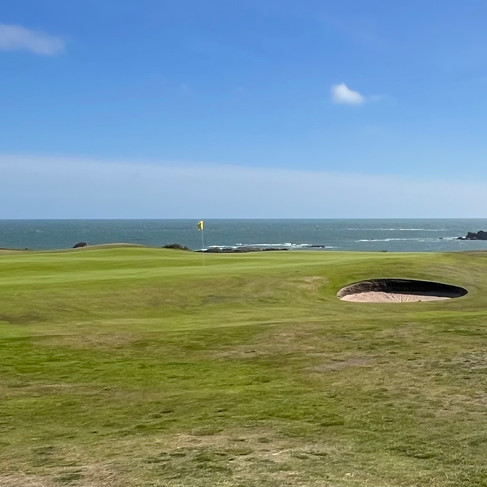
There are courses where the architecture is the star and there are courses where the land is the star. Cruden Bay is both at once. You walk off the 18th green and you can't tell whether you've just played one of the most brilliantly designed courses in Scotland or just spent four hours on the most spectacular piece of duneland nature ever handed to a golf course architect. The honest answer is both. Old Tom Morris laid out the original course in 1899. Tom Simpson and Herbert Fowler reworked it in 1926, leaving most of the routing intact. Tom Mackenzie made some sympathetic tweaks in 2014. Three Toms across 125 years and the course still feels like one coherent vision. That's because the dunes do most of the talking and the human designers all had the sense to listen.
I'd been wanting to play here for years. Finally got the chance on an Aberdeen-area golf trip where we did the full circuit. Trump International one day, Royal Aberdeen and Murcar another, Cruden Bay as the centerpiece. Trump is grandiose, Royal Aberdeen is properly old-school, Murcar is the slightly underrated next-door neighbour. All worth playing. None of them touch Cruden Bay for sheer fun.
Now, full disclosure. Cruden Bay is not for everyone. If you're the kind of golfer who needs to see every shot landing area from the tee, who hates blind shots on principle, who thinks a green should be visible from at least 100 yards out, you might find this course annoying. The 14th has a blind drive over a giant dune. The 15th is a blind par 3 where you wait for a bell to ring before you can tee off, because you can't see the green and have no way of knowing if the previous group has cleared it. There are little hidden punchbowl greens tucked into hollows between dunes. There are humps and ridges and unexpected slopes that throw seemingly good shots into terrible spots. If you came to play modern, sanitised, every-detail-visible golf, this is going to feel like nonsense.
I loved every second of it.
The quirks aren't a flaw at Cruden Bay. The quirks are the entire point. This is what golf used to look like before architects started worrying about being "fair." The land here doesn't care if it's fair to your golf game. The land has been doing what it's doing since long before anyone thought of playing golf on it, and the course just routes through it as elegantly as possible. You either embrace that or you don't. I embraced it.
Quick context on the place. Cruden Bay sits about 25 miles north of Aberdeen, in a tiny village that grew up around a fishing harbour and the old North of Scotland Railway hotel. The hotel was demolished in the 1950s, which is a tragedy because by all accounts it was something special, but the golf course survived because three local businessmen bought it. It plays par 70, around 6,500 yards from the back tees, which sounds short until you realise that the dunes and the wind do all the work that length would otherwise need to do.
The setting is genuinely one of the great golfing settings in the world. To the south you've got the ruins of Slains Castle on the cliffs, which famously inspired Bram Stoker to write Dracula on his summer visits here. To the north you've got the Bay of Cruden itself with its long pink-tinged sandy beach. The fishing village of Port Erroll sits behind the early holes. And surrounding all of it are these massive dunes, the kind that you don't really see in Scottish golf except at one or two places. Some people have called Cruden Bay the Ballybunion of Scotland because of the dune scale and that's not a bad comparison, though I think Cruden Bay has more variety of holes than Ballybunion does.
Right. Let me walk through some of the holes that stuck with me, because there are a lot of them.
The 3rd is called Claypits and it's a short par 4 of about 280 yards, drivable in the right wind, but the drive is blind over a ridge with no real way of knowing where your ball ended up until you walk up. The fairway tumbles down through humps and hollows to a green tucked in front of the river by Port Erroll. The setting is something like out of a postcard from 1910. I made a five and didn't care.
The 4th is the par 3 named Port Erroll. It's about 195 yards from an elevated tee carved out of one dune to an elevated green carved out of another, with a deep grassy hollow between them and the river running down the left. Into the wind this is one of the toughest par 3s in Scotland. The day I played it the wind was helping and I still left it short. There's no margin. You hit the green or you don't.
The 5th and 7th are big two-shotters through the dunes. Both excellent, both demanding well-struck shots, both rewarding good play with reasonable approaches.
The 6th is one of the great par 5s in the country. 517 yards from the white tees with a burn cutting across in front of the green. If you've hit a good drive you have a real decision. Go for it and risk losing your ball in the burn or in the wild rough that flanks the green. Or lay up and take your chances with a wedge. I laid up. Made par. I don't regret it.
The 9th tee is something I'll remember for a long time. It's at the highest point on the course, you've just played the front nine which has been mostly along the lower ground, and when you get to that tee box and look back, the whole front nine is laid out below you like a map. The bay, the dunes, the river, the village, the ruins of Slains Castle in the distance. It's one of the great views in Scottish golf and it's the kind of moment where you stop, take a photo, and accept that whatever you score on this hole is fine because you're just happy to be there.
The 14th is named Whins. Par 4, 431 yards, with a giant dune blocking the view from the tee to the green. The smart play is to lay back, hit a wedge in. The aggressive play is to challenge the dune and try to fly it. Most amateurs should not challenge the dune. I challenged the dune. I lost a ball. Then I dropped, hit a wedge, and walked off with a six that felt like a moral victory because at least I'd tried.
The 15th, Blin' Dunt, is the hole that defines Cruden Bay for most people. Par 3, 195 yards, completely blind from the tee. There's a hole sign that shows you a depiction of the green with a tee placed where the flag is positioned that day. There's a bell at the green that the previous group rings when they've cleared it, and you wait for the bell before you tee off. It is the most analog, old-school, slightly absurd hole I've played anywhere. I loved it. I missed the green, naturally, but the experience of walking up over the dune to discover where your ball had ended up was pure golf in a way that almost no modern course can replicate.
The 16th has a feature behind the green called The Coffins, which is a series of deep grassy hollows that swallow any approach hit too long. The name is appropriate. I avoided them mostly through luck.
The 17th and 18th bring you back toward the clubhouse with the dunes still in play and the views still doing their thing. By this point you've been on a journey and you're a little tired and a little exhilarated and you don't really want it to end.
The clubhouse is everything an old Scottish links clubhouse should be. Modest exterior, warm interior, full 180-degree view from the dining room over the course and the bay. They have a board with the visiting golfers' names written on it for the day, which is the kind of small touch that makes you feel like a guest rather than a customer. The food is good honest pub food, the staff are friendly without being obsequious, and the view from your table is one of the best in golf. We sat there afterward for an hour just looking out and replaying the round.
A note on cost. Cruden Bay is excellent value for a course of this quality. Summer weekend rates are around £180 last I checked, with weekday rates lower and a 36-hole day ticket option that's worth considering if you can hack two rounds in a day. Compare that to the £400-plus they charge over at Trump and you understand why so many golf trip planners are putting Cruden Bay on the itinerary instead of just the obvious headline names. You're getting a top-50-in-the-world course for less than half the price of the new flashy neighbour.
A few practical things. Walking only. Caddies are available with notice and worth booking for a first visit because the blind shots and the local knowledge will save you strokes. There's a decent practice area but nothing fancy. The pro shop has the usual logo stuff and I bought a hat because I always buy a hat. The drive from Aberdeen takes about 40 minutes through some pretty countryside.
Compared to the other courses on our trip. Trump is the most spectacular setting and the most expensive round, but it's also the most modern and the most American in feel. Royal Aberdeen is the proper old-school links experience and the front nine especially is excellent. Murcar is the friendly, slightly less heralded neighbour where you can have a relaxed round at a reasonable price. But Cruden Bay is the one I want to play again. It's the one I think about. It's the one where the holes are still floating around in my head months later.
If you're planning an Aberdeen-area golf trip, build it around Cruden Bay. Play the others as supporting acts. And go in willing to embrace the quirks because that's where the magic lives. The blind shots, the bell on 15, the giant dune on 14, the hidden green on 3, all of it. Modern golf course architecture has been steadily eliminating these features from new courses for decades because they're "unfair." The result is a lot of pretty courses that feel slightly the same. Cruden Bay is a reminder of what golf used to be like, and a reminder that the old way still has plenty to offer the curious golfer.
Go play it. Bring extra balls. Listen for the bell on 15.
Read also other reviews from the same trip: