Cape Kidnappers: Twelve Balls Were Not Enough
- Gunnar Kobin
- 5 days ago
- 5 min read

Updated: 2 days ago

This one is from a different trip. Not a golf trip at all, as it happens. I was in New Zealand with my family over the New Year, and we had stopped for New Year's Eve in a town on the North Island called Napier.
Napier deserves a paragraph of its own. The town was largely destroyed in 1931, when a large earthquake hit Hawke's Bay and the fires that broke out afterwards finished off most of what the quake had left standing. What makes Napier remarkable is what happened next. The town was rebuilt, more or less all at once, in the Art Deco style that was fashionable at the time. Walk the main streets today and it looks as though someone airlifted a slice of 1930s Miami Ocean Drive onto the New Zealand coast. Pastel facades, geometric detailing, the lot. It is a strange and lovely place to spend a few days.
While we were there I did what I always do in a new place, which is quietly check whether there is a golf course nearby worth playing. There was. I opened the website for Cape Kidnappers and more or less stopped breathing. If you have seen the aerial photographs, you know the ones. Fingers of green land running out toward the edge of cliffs, the Pacific a very long way down on either side. It is one of the most photographed golf courses on earth, and the photographs do not undersell it.
I started to book a tee time. Then I noticed the booking page was not exactly busy. Plenty of open slots. And I made what turned out to be a slightly naive decision, which was to drive out there without booking at all, on the theory that a course with that much availability would happily take a walk-up.
The drive from Napier is around forty minutes. You turn off the main road and arrive at a gate with an intercom. I pressed the button, said hello, explained that I would like to come and play a round. The voice on the other end told me the course was fully booked. I said that was strange, because I had been looking at their website about an hour earlier and it had shown plenty of space. There was a short pause. Then the intercom went dead. Not "let me check". Not "please hold". Just off.
I sat in the car for a moment. Then I got my phone out, opened the Cape Kidnappers booking page, and booked myself a tee time for thirty minutes from then. It went through immediately. I rang the intercom again and said, in a slightly more confident voice, that I had a booking. The gate opened.
What I did not know, and what I found out over the next half hour, is that the gate is nowhere near the golf course. Cape Kidnappers sits on an old sheep station of around six thousand acres, and the road from the gate to the clubhouse is about eight miles of narrow, winding, climbing farm track. I drove it faster than I should have, sheep watching me go past with what felt like mild disapproval, and arrived at the clubhouse more or less exactly at my tee time, slightly sweating, having passed no other car the whole way.
Somewhere on that road it clicked why they had turned me away at the gate. It was not really about whether the course was full. It was about not wanting one more unbooked tourist driving unsupervised across eight miles of private estate just to have a look around. The booking was the password. Once I had one, I was a golfer rather than a sightseer, and the gate opened.
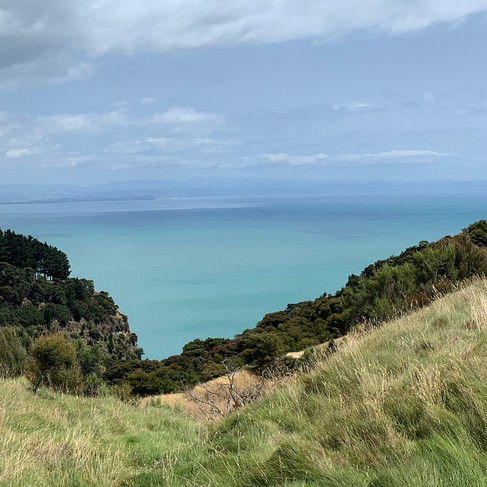
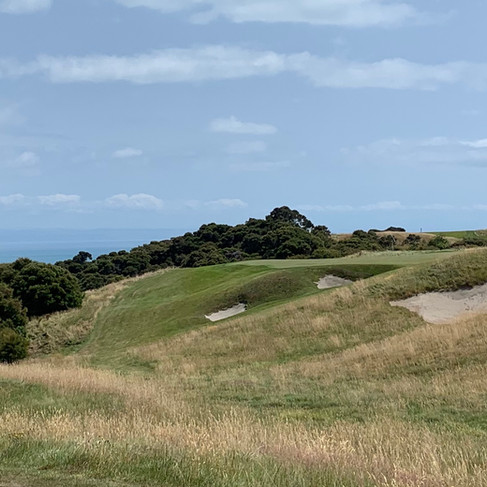
Now, the course. Cape Kidnappers was designed by the American architect Tom Doak and opened in 2004. It was Doak's first project outside the United States, and it was funded by Julian Robertson, the American hedge fund billionaire who fell for New Zealand and built two of its most famous golf resorts. The cliffs the course runs along stand about a hundred and forty metres above the sea. The front nine plays more inland, across ridge and valley, and the back nine is where the famous holes are, running out along those fingers of land toward the drops.
The name itself is older than the golf by some distance. The cape was named by Captain James Cook in 1769, during his first voyage to New Zealand. Cook had a young Tahitian boy travelling with his crew, and at this point on the coast a group of local Māori came out in canoes and tried to take the boy off the ship. The boy escaped and made it back aboard. Cook marked the headland on his chart as Cape Kidnappers, and the name has held for the two and a half centuries since, long enough to end up printed at the top of a golf scorecard.
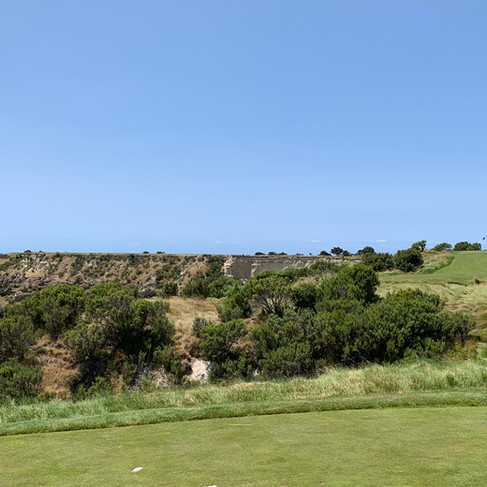
Here is the honest thing about playing Cape Kidnappers that the aerial photographs cannot tell you. You do not see the course the way the camera sees it. The camera is up in a helicopter, looking down, and from up there the fingers of land and the ocean and the shape of the whole thing are obvious and breathtaking. Down on the ground, inside the round, you do not get that view. You get a fairway in front of you, a steep fall-away on the left, a steep fall-away on the right, and a strong sense that the sensible miss does not exist. You can stand on a tee and know, intellectually, that you are on one of the great pieces of golf land anywhere in the world. What you actually experience, shot to shot, is lost ball left and lost ball right.
Which brings me to the balls. I was travelling with my family, not with my clubs, so I rented a set from the clubhouse and bought a box of twelve balls in the pro shop on the way out. Twelve balls. For eighteen holes. On a normal course, for a player of my standard, that is a comfortable supply with some spare. At Cape Kidnappers I was out of golf balls by the eighth tee. All gone. Every one of them somewhere down a cliff or in a ravine, feeding the local wildlife.
I had, fortunately, taken a buggy. So I did the only thing available to me, which was to drive the buggy back toward the clubhouse, walk into the pro shop, and buy another twelve. The person behind the counter did not say a word about it. I suspect I was not the first person to make that particular trip. I imagine they keep the ball shelves well stocked for exactly this reason.
I will not pretend I scored well. Scoring was never going to be the point of a day like that, and in any case the course had its own plans for my golf balls. What I will say is that Cape Kidnappers is, without question, one of the most spectacular places I have ever stood with a club in my hands. It is also genuinely hard, genuinely humbling, and nothing like the gentle, glorious visual experience the photographs quietly promise. You come away with a strange double memory. The grandeur, which is entirely real. And the slow, steady disappearance of two dozen golf balls into the South Pacific.
If you ever find yourself in Hawke's Bay, go and play it. Book first, obviously. Take more balls than you think you could possibly need. Then take more than that.