Old Head
- Gunnar Kobin
- Apr 25
- 8 min read


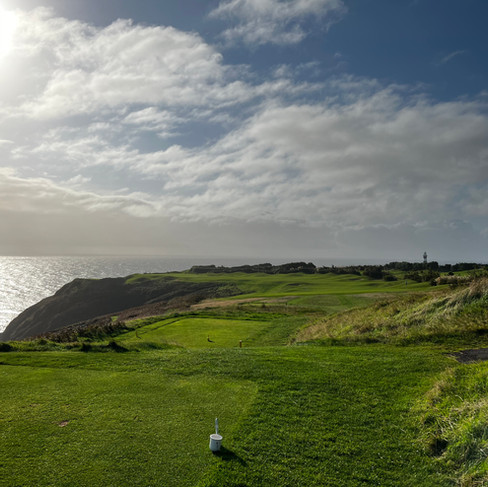
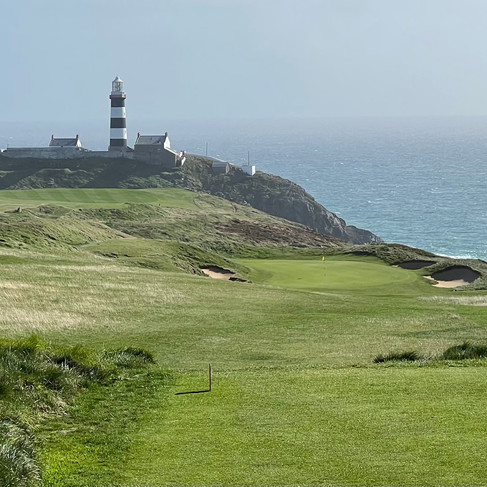
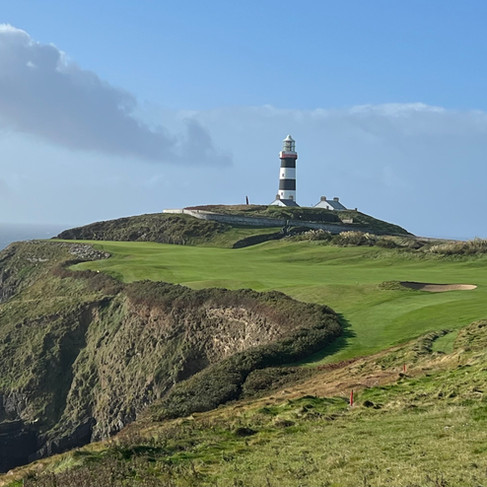
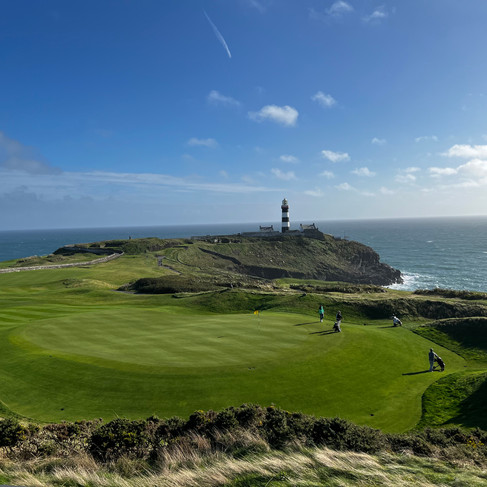
Most reviews of Old Head start by trying to describe the setting and immediately reaching for the same comparisons. Pebble Beach on steroids. The Cliffs of Moher with golf on top. A video game come to life. I've read all of these phrases multiple times and they all undersell what the place actually is. Old Head is a 220-acre piece of land that sticks two miles out into the Atlantic Ocean, hooked to the south coast of Ireland by a narrow road barely wide enough for two cars to pass. Driving onto the property feels like driving onto an island. The cliffs around the edge of the headland fall 300 feet straight down to the water. A lighthouse stands at the southern point, white against the blue, marking what used to be one of the most dangerous stretches of coast in Europe. The Lusitania was sunk just offshore in 1915.
There's a memorial in the clubhouse.
That's the setting. The golf course occupies most of it, with the cliff edges framing the playing corridors and the Atlantic providing the soundtrack and the constant wind doing what the constant wind does. I played it on a sunny day with the wind blowing properly hard. By the back nine I had given up trying to hit my normal yardages and was just trying to keep the ball in play.
You don't book Old Head online. You fill in an enquiry form and they get back to you. Green fee is €395 in peak season, dropping to €225 at the very start and end of the year. We paid the peak rate. If you're going to do Old Head you may as well do it in summer when the weather has the best chance of cooperating. Some people will tell you €395 is too much for a single round of golf. Those people are not wrong. But Old Head doesn't really compete on the price-per-hole metric. You're paying for the headland, the lighthouse, the Atlantic, the cliffs, the entire absurd geography of the place. If you measure it that way the value calculation looks different.
This was part of a longer Irish trip. We'd been at Doonbeg and Ballybunion earlier in the week, then drove south to Cork for two nights with Old Head as the centerpiece. The drive from Doonbeg down to Kinsale takes about three and a half hours through some of the prettier parts of southwest Ireland. We stopped in Limerick on the way and had a long lunch that turned into a longer afternoon, which I'll come back to in another post some time. Anyway. Got to Kinsale in the evening, stayed at a small hotel in town, drove out to Old Head the next morning.
The road out to the headland is part of the experience. You leave Kinsale and head south through farmland on a road that gets progressively narrower until you're on what feels like a single-track lane with stone walls on either side. Then you crest a small hill and the headland appears in front of you, a green diamond pushing out into the ocean with the lighthouse visible at its southernmost point. I pulled over and took a photograph because that's what you do.
There's a guard at the gate. You don't get past him without a confirmed tee time. Once you're through, you drive up the hydrangea-lined approach to the clubhouse and the practice area, and you start to register the scale of the place. There's a helipad. They take helicopter arrivals seriously enough to have built a four-helicopter pad. We came by car like normal people.
The American thing at Old Head is its own ecosystem. There are American golfers who book themselves into the on-site hotel for a week, fly in by helicopter, and use Old Head as a base from which to helicopter out to other Irish courses for day trips. Doonbeg in the morning, Lahinch in the afternoon, back to Old Head for dinner. I overheard a conversation in the bar about which courses on the island had decent helipads and which required a longer transfer from the nearest landing site. This is a specific golf travel demographic that I had read about but never seen in the wild. Now I have. The Old Head accommodation pricing presumably accounts for this market.
The clubhouse has a Lusitania-themed bar that I found slightly unusual but the food was good and the staff were welcoming. There's something about the international clientele at Old Head that gives the place a slightly stateless feeling. You're in Ireland but the membership is global and the atmosphere isn't particularly Irish in the way that, say, Lahinch is Irish. That's not a complaint. Just an observation.
OK, the golf.
The 1st hole is the weakest hole on the course and that's deliberate. Ron Kirby, who routed the place over two years living on site, knew that he had to give golfers a moment to settle in before throwing them onto the cliffs. So the 1st is a flat-ish par 4 heading away from the ocean. You make par or bogey, you take a deep breath, you walk to the 2nd tee. And that's where Old Head starts.
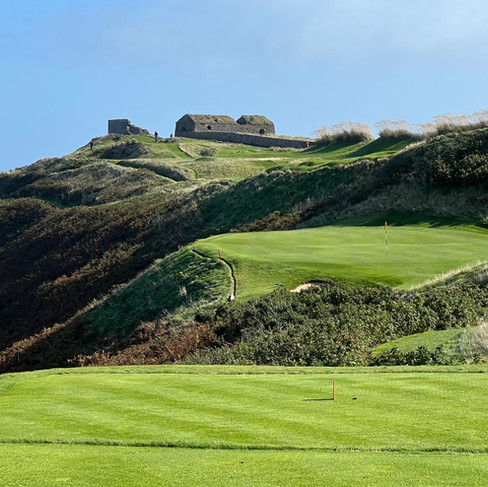
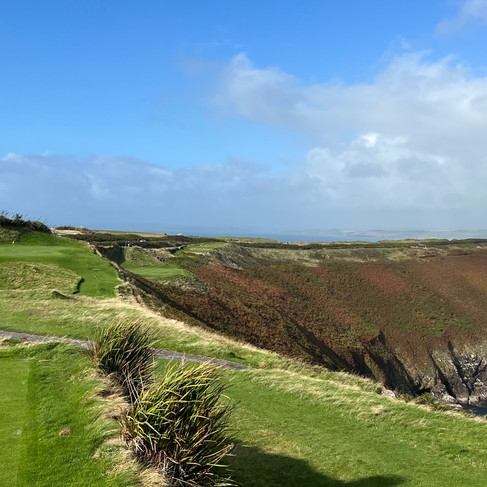
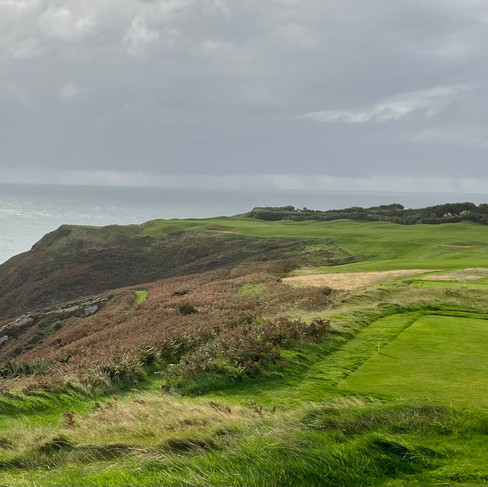
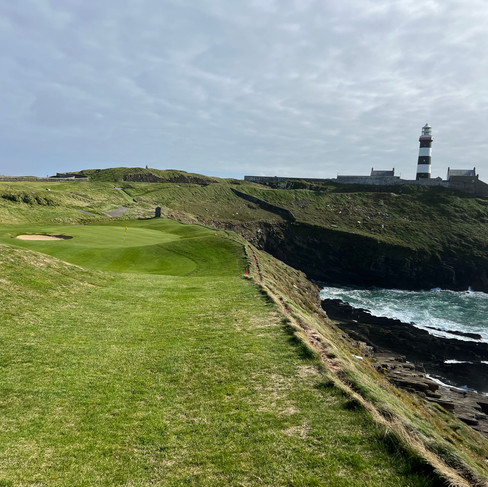
From the 2nd through about the 13th the course routes you along the cliff edges, weaving inland and back to the water in patterns that maximise the dramatic moments. The 4th has a tee shot that runs along the cliff with the Atlantic 300 feet below on your right. You aim down the fairway and try not to think about the drop. I aimed for the safe side. Hit the fairway. Felt heroic about it.
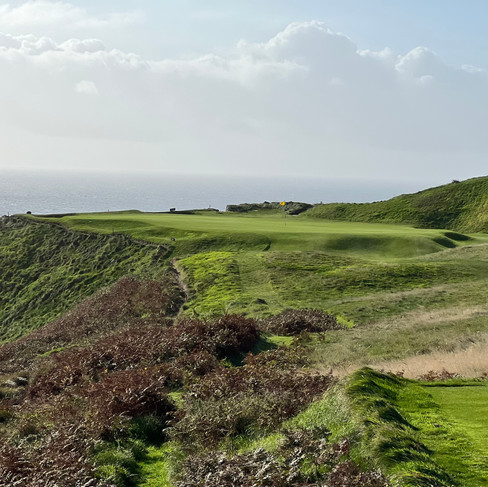
The 12th is the one everyone talks about. Par 5, the tee cut into the cliffs, blind drive uphill toward a hidden fairway. I was told before I teed off that some golfers have actually been escorted off this tee with vertigo symptoms. I'm not normally bothered by heights but standing on that tee with the wind blowing into your face and the cliffs falling away on both sides is genuinely intimidating. I hit my drive without watching where it went and walked over the crest hoping for the best. Found my ball in the fairway. Made bogey after a thinned second shot. Didn't matter. I'd played the 12th at Old Head.
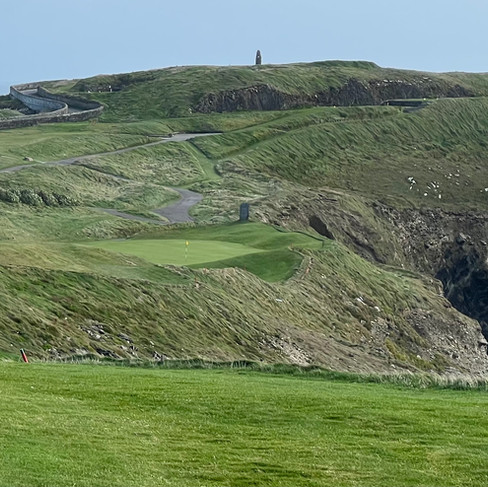
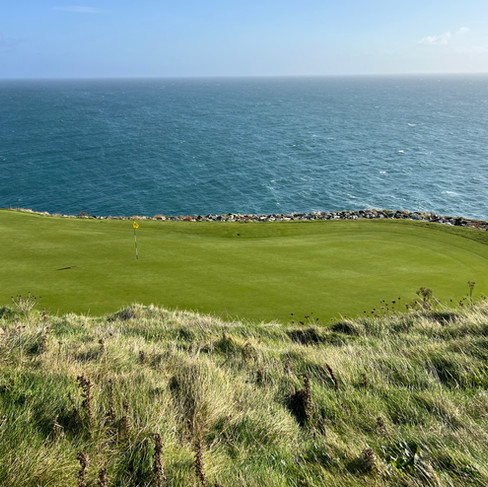
The 13th is a short par 3 that clings to the side of the cliff with the green sitting on a small ledge. Wind off the Atlantic pushing your tee shot. I missed left, hit a chip that ran past, two-putted for bogey. Walked off thinking that was probably the most exposed feeling I'd ever had on a golf course.
The 17th is called Lighthouse and it's a 623-yard par 5 that runs back along the headland with the actual lighthouse standing tall in the background. The hole demands a bold second shot to the right side of the fairway. Anything left leaves a blind approach to a green nestled in a punchbowl on the cliff edge. I went left. Hit a blind approach. Got lucky and found the green. Two-putted for par and felt I'd stolen one.
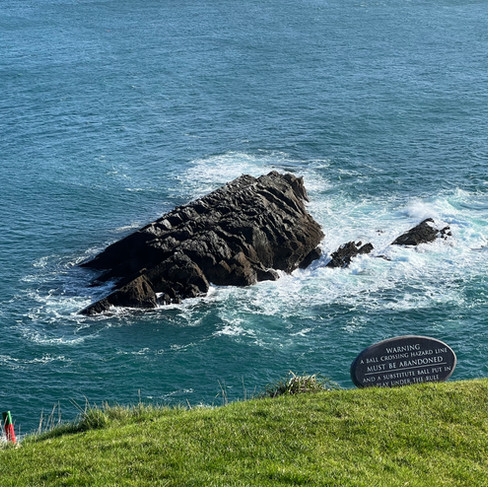
The 18th is the closer that lives up to the rest of the course. The back tee is on a narrow peninsula sticking off the southernmost point of the headland with the lighthouse looming behind you and the ocean falling away on three sides. Walking down the path to that tee box is a moment. I've never felt smaller on a golf course. The hole itself is a 434-yard par 4 with out-of-bounds right, a forced carry over a rocky inlet, and an approach into a green that sits in front of the clubhouse. I made bogey. Walked off the green grinning anyway because I'd just finished one of the great rounds of my life.
The wind. Let me come back to the wind. Old Head in calm conditions would be a different course. The day we played, the wind was gusting hard enough that several shots were nearly unplayable. Tee shots that would normally be 250 yards were finishing 180. Wedge shots from 100 yards were ballooning into the sky and coming down 30 yards short. The greens were holding well enough but reading them with the wind pushing your putter at address was a separate skill. By the back nine I had stopped caring about my score and was just enjoying the experience of trying to play golf in conditions that were genuinely at the edge of what's playable. I think that might be the best way to play Old Head. You're never going to score well here. The course is too long, too exposed, too much. So just stop worrying about the number and enjoy the holes.
Caddie was excellent. Old Head has 160 caddies on the books in season, more than just about any other club in Ireland. We took caddies because we'd been advised to and because the course is too difficult to navigate on a first visit without local knowledge. Worth every cent on top of the green fee. He read greens we wouldn't have read, picked lines we wouldn't have picked, and carried our bags up some genuinely steep slopes without complaining once.
Some practical things. Walking is encouraged but carts are available, which is unusual for Ireland's top courses. Most premium Irish links don't allow carts at all. Old Head does because the walk is genuinely strenuous and they want the place accessible to people who can't manage three hours of clifftop hiking. The accommodation on site is excellent if you want to stay over and play it twice, which a lot of visitors do. The clubhouse has been upgraded significantly in recent years and the suite of services around the golf is now proper resort-level.
So is Old Head a real links course? No, not technically. The cliff-top setting and the firm turf give it a links-like character but real links courses sit on sandy soil at sea level and Old Head is on a headland 300 feet above the water. There's been a lot of debate about the use of the word "links" in the name. I don't really care. It's a great course on the most spectacular piece of golf real estate in Europe and the technical classification doesn't matter much to me as a golfer.
Where does it sit in my Irish golf rankings? Top 5 of what I've played. Not the best Irish course I've experienced (Royal County Down still has that title for me) but the most spectacular and the most memorable. I would play Royal County Down more often than Old Head if I had to choose because Royal County Down is the better golf course. But if someone said I could only play one Irish course one more time and that was it forever, I'd probably pick Old Head, because nothing else gives you that feeling of standing on a clifftop tee with the Atlantic at your feet and a flag fluttering in the distance.
Walking off the 18th green, one of the friends I'd organised the trip with turned to me and said something I'm going to remember for the rest of my life. He said that whatever differences we might come across in our lives, he would always owe me for this round. That's the best compliment I've ever received for organising a golf trip and probably the best compliment I'll ever receive. We were both standing there looking back at the lighthouse with the Atlantic crashing below and the sun going down over Kinsale Bay and there was nothing else to say.
That's what Old Head does to people. That's what you're paying €395 for. Not the golf course, not really. The moment with your friend afterward when neither of you has the words.
Worth every cent. I'd go back tomorrow.
A footnote on the Lusitania. The clubhouse has a memorial to the 1,198 people who died when the ship was torpedoed in 1915 just off the headland. It's a small thing tucked into the bar but worth a look. Fishermen from Kinsale rowed out to try to rescue survivors. Some made it back. The wreck still sits on the seabed about 11 miles south of where you tee off on the 18th. There's a heaviness to the history of this stretch of water that the bright blue sunny days don't entirely cover up. Worth knowing about as you walk the course.






















Comments