Castelconturbia Golf Course – Championship Golf in the Piedmont Countryside

Updated: Oct 22

The drive up to Castelconturbia takes you through rolling hills and mature forest, and you get a sense of what is coming. It does not fully prepare you, though. At the clubhouse the meadows and woods only hint at the course. It reveals itself slowly, and it never shouts about what it has.
Some courses are peacocks. Castelconturbia is the other kind. It has serious architecture, a lot of natural beauty and enough room to host championships, and it does very little to promote any of that.
The club sits in the Piedmont countryside just north of Milan, close to Lake Maggiore. It feels calm and quietly elegant. Unusually for a course of this profile, it is removed from outside distractions. The place exists for golf, and when you are left alone to get on with it, focus and rhythm come naturally.
A bit of history. Castelconturbia was a collaboration between Robert Trent Jones Sr and Jr. It has 27 holes, arranged as three looping nines, and the design mixes classical and modern ideas. The course has hosted a number of professional and elite amateur events, including the Italian Open, and it has consistently ranked among the top courses in Northern Italy. After playing it, I could see why.
OK, the actual golf.
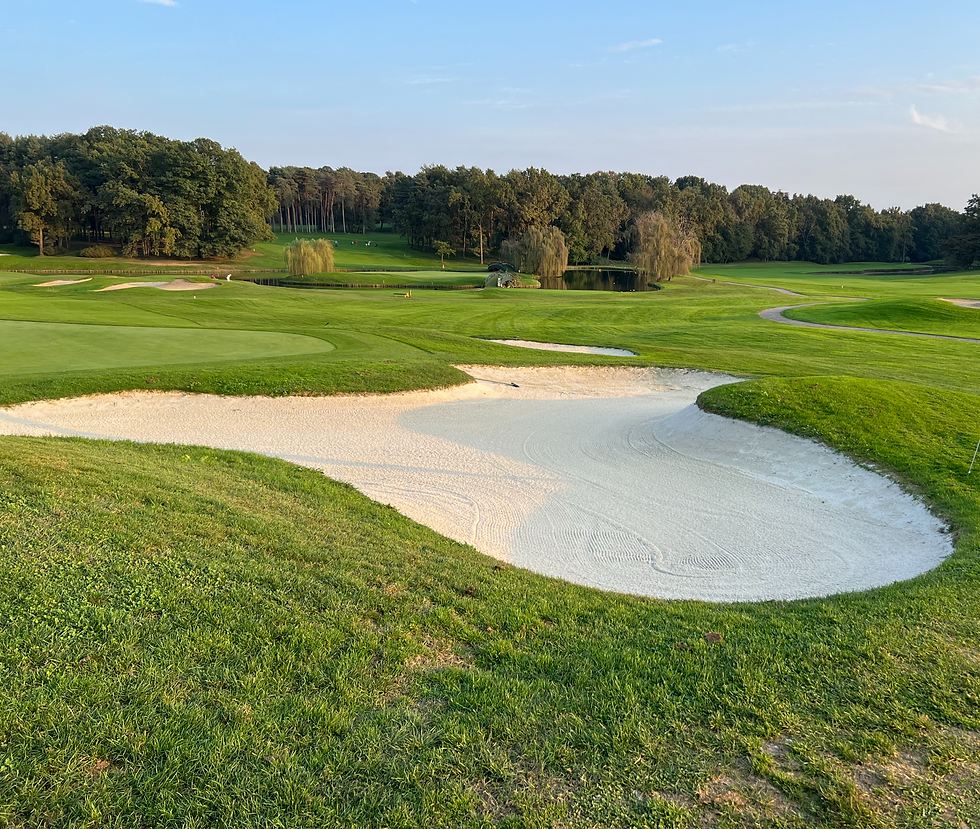
The Joneses balanced generous corridors, subtle contouring and precise green complexes, and the result is a course that is playable but never lets up. The routing follows the land rather than forcing shapes onto it. Fairways rise and fall where the ground does. Bunkers are placed for strategy rather than decoration. Water is used deliberately.
The thing that struck me most was how clear the strategy is. Every hole asks a question, but there is rarely only one answer. Angles into the greens matter. A well-placed tee shot gets rewarded. The aggressive line is always there, but it is high risk and needs full commitment and a precise strike.
Each of the three nines has its own character, but they share the same architectural language: rhythm, variety and sensible shot values. There are no jarring transitions or long walks between holes. Tree-lined fairways give way to open space and back again, and that shift between enclosed and open keeps every section interesting. There are no dull stretches and no artificial carries.
The landing areas off the tee are generous. The real job is putting the first shot in the right part of the fairway for the second. That is where most players slide into awkward spots. Lines that look fine from a distance lead you into trouble, and the design keeps nudging you to hold back rather than force it. Patience is a big part of any game plan here.
Wind is mostly taken out of play by the setting, but the elevation changes, the tree lines and the order of the holes build the pressure as you go. The greens get firmer and the demand for precision rises towards the end of each nine.
The greens are the kind northern Italy does well: true, with subtle movement that tests your read. The differences are small, but they are enough to separate a good putt from a tricky one. Missing a green is where the hard golf starts. You need delicate bunker shots, low runners and lofted pitches, and the course rewards touch and imagination around the greens rather than power.
Conditioning was excellent when I played. Good fairways, greens that rolled smooth and true, well-kept bunkers. The presentation tells you this is a club that values design over spectacle. No needless visual tricks, no excessive shaping, no artificial dressing. Everything is there for a reason.
My own round was in October 2023, on the Red and Yellow nines from the yellow tees, which carry a slope of 142. That number turned out to be accurate. I went out in 49 and came back in 45 for 94.
The front nine had an 8 on the par-4 7th and another 8 on the par-5 9th, which is a fairly efficient way to turn a respectable nine into 49. On the back nine the par 5s were the trouble again, with two 7s.
The odd thing is the par 3s. All five of them, I made par. Every one. So the short holes were the only part of the course I had under control. The longer holes are where all the strokes went.
That is a fair summary of the course as well. It does not hit you with anything dramatic. It just keeps asking for good positioning and good decisions, and the strokes add up if you do not provide them.
Under tournament conditions the course is a fair but demanding test. Precision, discipline and intelligent choices win. The layout is built to find the complete golfer, not just the one who drives it furthest. The routing, the quality of the green complexes and the overall balance all show that tournament pedigree.
The clubhouse continues the theme: calm, elegant and restrained. There is a strong sense of tradition, but nothing feels stiff. The terraces look out over the course and are a good place to sit after the round.
The practice facility is built with golfers in mind, with a large driving range and several short-game areas. Everything about the place says members' club and championship venue rather than commercial resort.
Final word.
Castelconturbia runs on quiet confidence. It does not need dramatic features to get attention. It is simply designed to be an outstanding course. What impressed me most was how complete it felt. The layout, the conditioning, the atmosphere and the service all lined up, and despite the 94 it was a memorable and very satisfying day.
Should you play it? If you are planning a golf trip to northern Italy, Castelconturbia belongs near the top of the list. It is one of the best courses in the region, and it stands with the best in the country. It just will not tell you so itself.


Comments