Avalon Golf Estate, Mauritius: Up in the Clouds, Away From Everything
- Gunnar Kobin
- Mar 26
- 4 min read


Avalon Golf Estate feels like a farm not as a golf course (in a good way)
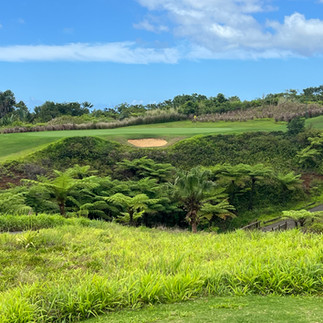
Leave the lagoons, palm trees, and turquoise waters to the other courses on Mauritius. Avalon Golf Estate is situated on top of a mountain surrounded by tea plantations and gorgeous views, including the southern coastline on a clear day, with ferns and monkeys nearby. You will feel like you are on a completely different island.
I was at my hotel, Heritage Telfair, on the southwest coast, and then took a full hour to drive to the course, which I had underappreciated. The road steadily climbes to higher elevations and the tea fields, cooler air, and disappearing sea transform the landscape. By the time you arrive, you half expect to see a different flag flying at the clubhouse. It's worth the drive, but for a casual morning round, book it knowing what you're truly signing up for.
The Weather Problem Nobody Talks About
Being on a mountain in the tropics has its perks. The weather has no obligation to mirror the weather on the coast.
I've talked to people who drove up from their resort on a bright sunny morning, who then climbed into the clouds somewhere on the road, and then spent their entire round in a grey wet mist while the beach below them was apparently baking. It's not a hypothetical. It happens with enough regularity that it's the first practical thing I'd tell anyone booking this course: check the weather for Bois Cheri, not for your hotel. They can be completely different weather days at the same altitude.
When the weather is right, which is often, the highland air is much cooler than the coast. Playing golf at 25 degrees versus 30 degrees may not sound like a huge difference, but after doing a full round at Anahita in the mid day heat, it's a very different experience.
What the Course Actually Feels Like
Old farm is the phrase I kept coming back to. Not run-down — the greens are well kept and the fairways are mostly fine — but settled and unpolished. Resort courses never have this feeling. No manicured hotel gardens framing the tees. No designer signage on every tee box. The land just feels like it was here before the golf and the golf got fitted around it, rather than the other way around.
The course designer is South African course architect Peter Matkovich, and the course opened in 2015. It is course is par 72 over around 6,300 yards, built across a plateau. There are natural ravines doing most of the heavy lifting as far as hazards are concerned. No looping back to the clubhouse after nine — the two halves go off in separate directions, so once you're out there, you're out there. The buggy isn't optional. Some holes require a proper drive between tee and fairway and walking it in the highland wind would make for a long day.
It's quiet. Truly quiet. I think I only saw one group playing the hole I played. No one waiting. No one rushing you. No one is standing behind you waiting to tee off. This kind of pace is becoming less and less common in Mauritius and it really alters the vibe of the round.
With the open fairways and the lack of trees you really feel the wind blow across the plateau. You have to really think about your club selection. There are enough elevation changes combined with wind to catch you out more than once. Also watch out for the ravines that cross the fairway.
A Suggestive Approach
The 4th hole is a par 4 that features an entire group discussion. The elevation change favors the player as they take their first shot; the hole plays shorter than the scorecard. If a player hits a good first shot, they could reach the green. The first shot going straight means a lot. A steep ravine is positioned below the green, and anything going to the right will get penalized. Competition is a good thing, and the combination of elevation change, urge to hit the green, and a waiting ravine makes a good hole. The par 4 13th hole also deserves an honourable mention. A stream runs adjacent to the right side of the hole and, as is common for many elevated and well-bunkered greens, the green is cut off in front by the stream. It is relatively easy to get to the fairway and approach the green, and yet, many people find themselves with a double bogey. The green is also elevated and falls steeply in the back.---
Fairways, Some Greens, Monkeys
The pace of the greens is noticeably slower than Anahita and the Legend and you may need some time to adjust to it \. They are, however, in decent shape. Because some of the fairways have kikuyu creeping in, the ball may be sitting in a way that complicates contact and can sit under the ball. These issues are not big enough to ruin the round but are worth mentioning.
The monkeys are legit. They appear every few minutes on the edge of the course and very little is done about them. While I was at a par 3 tee figuring out the yardage, one showed up next to me and didn’t move at all. It is the type of thing that describes a round more than birdies and pars do.
With some people describing the curry as the best they had on the island, the Magic Spoon restaurant serves some of the best Creole food. After a round in the Highland wind that took more out of me than I expected, it was exactly right.## Should You Make the Drive?
Yes. This is a proper golf trip. Do you want something that feels different from the rest of the offerings of Mauritius? Yes? Then the drive is worth it. While coastal courses provide beautiful views and offer solid golf, they all share a similar visual vocabulary. Avalon is different and all on it’s own. The different mountain setting and farm-like quiet (with the weather being a bit of a risk/varying on the trip) all add up to a round of golf that you will describe different from all the other courses.
Just check the weather for Bois Cheri and give yourself the full hour from Heritage Telfair.






Comments